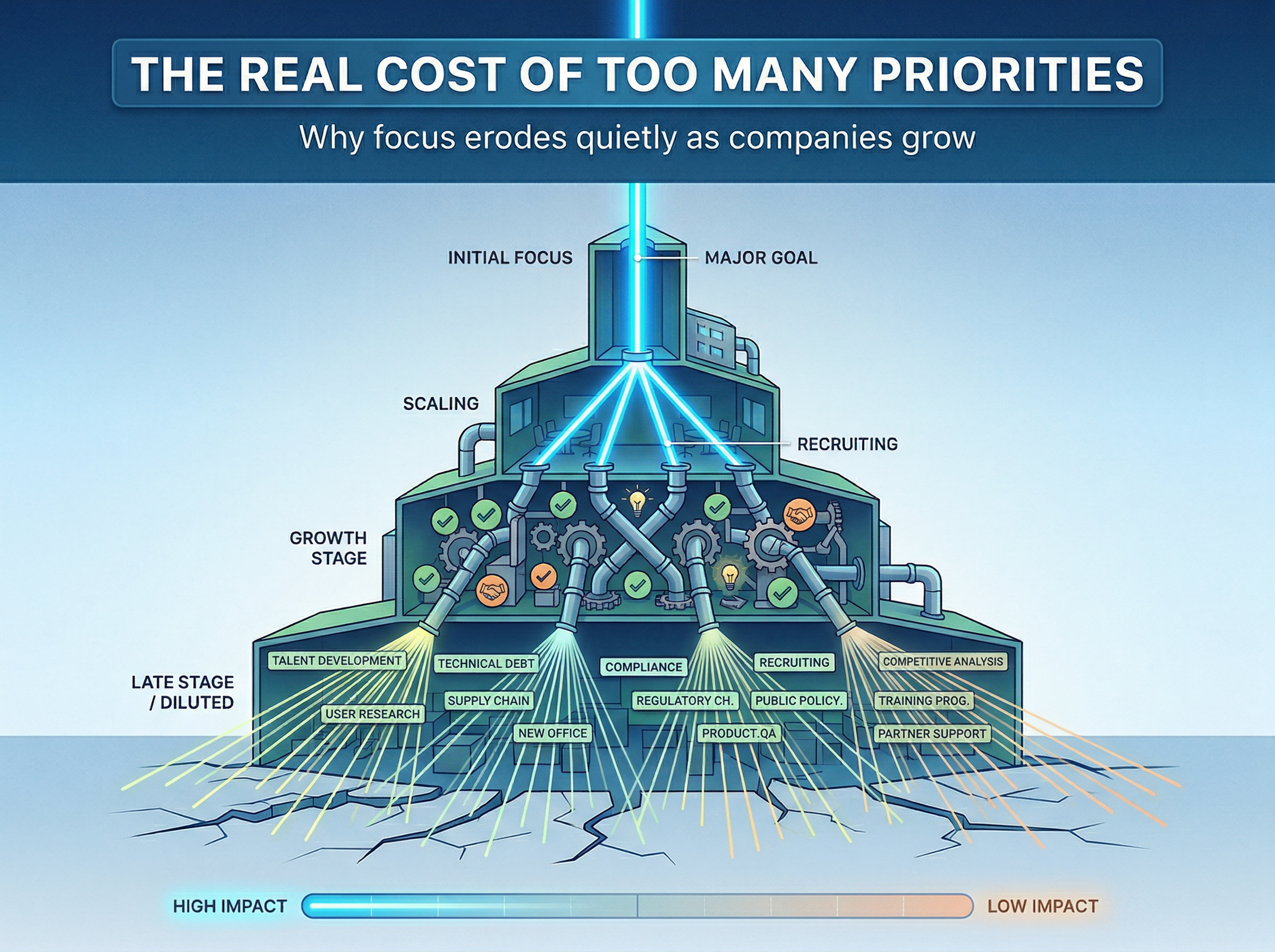
“The essence of strategy is choosing what not to do.”
— Michael Porter
Most growing companies don’t struggle because they lack opportunity.
They struggle because they refuse to subtract.
On paper, every initiative makes sense:
- Enter a new market
- Ship another feature
- Hire ahead of growth
- Upgrade infrastructure
- Improve internal systems
- Refresh the brand
Each one is defensible.
Each one sounds strategic.
Collectively, they dilute momentum.
👉 If your team feels busy but outcomes aren’t compounding, happy to compare notes.
The Illusion of Progress
When priorities multiply:
- Roadmaps get longer
- Meetings expand
- Reporting layers increase
- “Alignment” becomes a recurring theme
From the outside, it looks ambitious.
Inside the organization, attention fragments.
And attention is the scarcest resource in any growing company.
Before vs. After
Before
- One dominant objective
- Decisions anchored to that objective
- Tradeoffs were visible
- Teams moved decisively
After
- Five “top priorities”
- Decisions evaluated through multiple lenses
- Tradeoffs softened to avoid conflict
- Teams move carefully instead of confidently
Nothing dramatic breaks.
Focus just diffuses.
The Hidden Tax of Expansion
Too many priorities quietly create:
- Context switching
- Half-finished initiatives
- Leadership fatigue
- Competing success metrics
- Friction between teams
When everything is important, clarity disappears.
And when clarity disappears, execution slows — even if headcount increases.
Why Leaders Hesitate to Narrow Focus
Growth introduces opportunity.
Opportunity creates optionality.
Optionality feels like leverage.
But optionality without constraint creates drift.
Leaders often hesitate to eliminate priorities because it feels like closing doors.
In reality, subtraction is what restores force.
A Simple Reflection
Ask your leadership team:
If we could only succeed at one initiative this quarter, which would it be?
If the answers vary widely, momentum is already thinning.
Clarity at the top determines speed everywhere else.
The Discipline of Subtraction
High-performing organizations don’t just decide what to pursue.
They deliberately decide what not to.
They understand that:
- Focus compounds.
- Energy scattered does not.
- Fewer priorities increase conviction.
- Conviction accelerates execution.
Saying no feels uncomfortable in the moment.
But strategic subtraction is what protects long-term momentum.
👉 If your organization is wrestling with competing priorities as you scale, I’m always open to comparing notes.
👉 Sign up here to get new posts straight to your inbox.
Or reach out directly at insights@nurdsoft.co.